CARBON
FIBER FREQUENTLY ASKED QUESTIONS 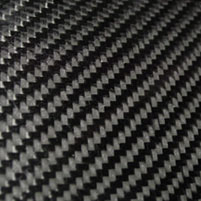
What
is Carbon Fiber?
The premise behind the Carbon
Fiber sheets we sell is for lightweight and good-looking
structural material, cosmetic enhancements, and damage protection.
The sheets we sell are an advanced composite- a material of choice
for the aerospace, automotive racing, marine, and sporting goods
scenes.
Benefits
include:
- Very
high strength to weight ratio
- High
resistance to fatigue
- Harmonic
dampening characteristics
- Impact
resistance
- Low
coefficient of thermal expansion
- Resistance
to corrosion.
"Composite"
is a general term which means an assembly of dissimilar materials
used together. They are carefully engineered and are uniquely
suited to be extremely strong and surprisingly light weight.
These materials consist of a resin matrix and a fiber reinforcement.
We
use high quality MGS epoxy resin that is approved for the production
of certified aircraft parts. We also use a variety of the main
fabric reinforcements from leading carbon fiber manufacturers including
Grafil Inc, Hexcel and Toray.
Not
only do we utilize Carbon fiber, we also use Kevlar, E Glass, S
Glass as well as hybrids of each.

Why
is it more expensive than products made of traditional materials?
There are three primary reasons for this:
1. All of the primary raw materials are expensive.
2. Construction of each product is complex, there are many materials
that are used to produce the final product.
3. The construction of each product is labor intensive and must
be done by a skilled composite technician. There is no way for
machinery to build the products
Be
warned- a lot of the 'carbon fiber' on the market today is FAKE,
but not ours! Read more about this here.
How
soon will I get my order?
Most of the carbon fiber sheets we sell are made-to-order,
so it may take up to a few days before your order is ready to ship.
Mixed bags and sample packs can usualy be shipped within 24-48
hours. Shipping is typically done via US Priority Mail (the shopping
cart will use UPS calculations for shipping however). International
shipments are usually by Global Priority Mail or Air Mail.
Unfortunately,
we will NO LONGER accept UPS 2-Day or faster orders. All carbon
fiber orders ship standard service.
I
want a custom size that I don't see in your lists, how can I
get a quote?
For your convenience, we've set up a Custom
Order Page, which will give you real-time price and weight
quotes on just about any carbon fiber sheet you might need- up
to 50 by 100 inches!
If
you are looking to place a very large order, or have special requirements, contact
us with your request.
How
can I gauge the thickness of these sheets?
The sheets we have come in various thickness from .013" to
.125". To give you an idea, we've created the following references:
- 0.015" (0.38mm) is
pretty thin, only about as thick as 2 pieces of paper stacked.
It is easy to cut with a scissors, and can be bent around a
cylinder without much effort. This is most commonly used in
cosmetic applications, and installations where looks are more
important than protection and rigidity.
- 0.023" (0.58mm) is
about as thick as if you stacked 5-6 pieces of paper on top of
each other. You can cut it with a good pair of scissors, and
it will bend, just not as easily as .015.. Good for applications
that want a little more protection, while still looking great.
- 0.041" (1.0mm) starts
to get pretty rigid. As a refernce, a standard audio CD is .048,
so it's just barely thinner than a CD, but try bending a CD,
now imagine that the .041 Carbon Fiber sheets are TWICE as rigid
as that CD! This stuff is great. Cut it with a saw, unless you
have a very strong pair of industrial scissors.
- 0.059" (1.50mm) is
just under 1/16" thick, it is a little thicker than a standard
0.48" audio CD. It is quite rigid, and will not easily bend around
any surface. Makes great material for small structural application
or impact resistance.
- 0.125" (3.175mm) is
a full 1/8" thick. Very durable and rigid. Try bending this,
and you'll understand that composite materials are amazingly
strong and durable. Great for structural material. You will definitely
need a saw to cut this. Finish the edges with fine sandpaper.
- 0.25" (6.35mm) is
a full 1/4 inch thick. This is some serious stuff. No way you'd
be able to bend this even by standing on it. For most purposes,
this thickness is way overkill, but some of our customers have
requested it to cut out small carbon pieces.
How
do I cut it?
For the thinner pieces (.020 and smaller), you can actually just
use a good pair of scissors. Thicker material you may be able to
use a tin-snips, but the optimal method is to use a band saw or
scroll saw. Fast-cutting, as with a jigsaw or circular saw tends
to make a lot of dust, and can leave a less-smooth cut, so slow-cutting
is typically better. When using a saw, it is a good idea to protect
the glossy finish from scratches, with some masking or similar
tape. Finish up the edges with a 100 grit sandpaper to take the
rough spots off, then detail with 400 grit. If you're really fancy,
you can use a Waterjet or
Laser-cutting service. (Although laser-cutting carbon fiber tends
to really stink as the material burns!)
What
are the dangers?
Much of what you may have heard about cutting carbon fiber is either
flat-out untrue, or can be avoided easily. The main thing you need
to know is wear protection! Whether you're cutting or sanding,
you need to wear eye protection, mask, and long sleeves. Gloves
are wise to use as well. Basically, the less exposed skin you have,
the better. Don't breathe the dust (another reason to use slow-cutting
methods- less dust). Basically the main danger is splinters. They
are annoying and can be painful, so just be careful to avoid them.
Did we mention DON'T BREATHE THE DUST. Click
Here for a complete Materials Safety Data Sheet.
Where
can I buy it?
Right
here
Want more information
on composites? Check
here. |